Asia Exposomic School: Overview

The Asia Exposomic School is a regional training and collaboration platform designed to advance exposome research in Asia. The School aims to equip researchers with the knowledge, tools, and practical skills needed to study how environmental, behavioral, social, and biological exposures jointly influence human health across the life course.

Exposome science provides a new framework for understanding disease prevention. Rather than focusing on single exposures, it examines the combined and cumulative effects of multiple exposures, from early life to adulthood. This approach is especially important in Asia, where rapid urbanization, industrialization, climate change, lifestyle transitions, and environmental hazards create complex health challenges.

The School will provide hands-on training in exposure assessment, biomonitoring, epidemiologic study design, statistical modeling, machine learning, and multi-omics integration. Special emphasis will be placed on birth cohort research, developmental origins of health and disease, and precision prevention.

By leveraging regional networks such as the Birth Cohort Consortium of Asia and connecting with international exposome initiatives, the Asia Exposomic School seeks to strengthen research capacity, promote cross-country collaboration, and support the translation of exposome science into public health action and policy.

Positioning Taiwan as a regional hub, the School will bring together graduate students, postdoctoral fellows, junior faculty, and cohort investigators from Asia and beyond. Through structured lectures, practical workshops, and collaborative discussions, the program will help build the next generation of exposome researchers and contribute to healthier, more resilient populations.

The emerging trend of exposomic studies

The emerging trend of exposomic studies reflects a paradigm shift from single-exposure assessments toward a comprehensive, life-course–oriented understanding of how complex environmental, behavioral, and social factors jointly influence human health. Advances in high-resolution exposure assessment, biomonitoring, and multi-omics technologies have enabled the systematic characterization of multiple, correlated exposures across critical windows of susceptibility. In parallel, the development of scalable statistical and machine-learning approaches has made it increasingly feasible to analyze high-dimensional exposomic data and to integrate them with genomic, epigenomic, and metabolomic information. These methodological innovations have accelerated the application of the exposome framework in epidemiology, supporting more precise identification of modifiable risk factors, improved causal inference in environmental health, and the translation of complex exposure profiles into actionable strategies for precision prevention and public health policy.
Exposome and Developmental Origins of Health and Diseases (DOHaD)

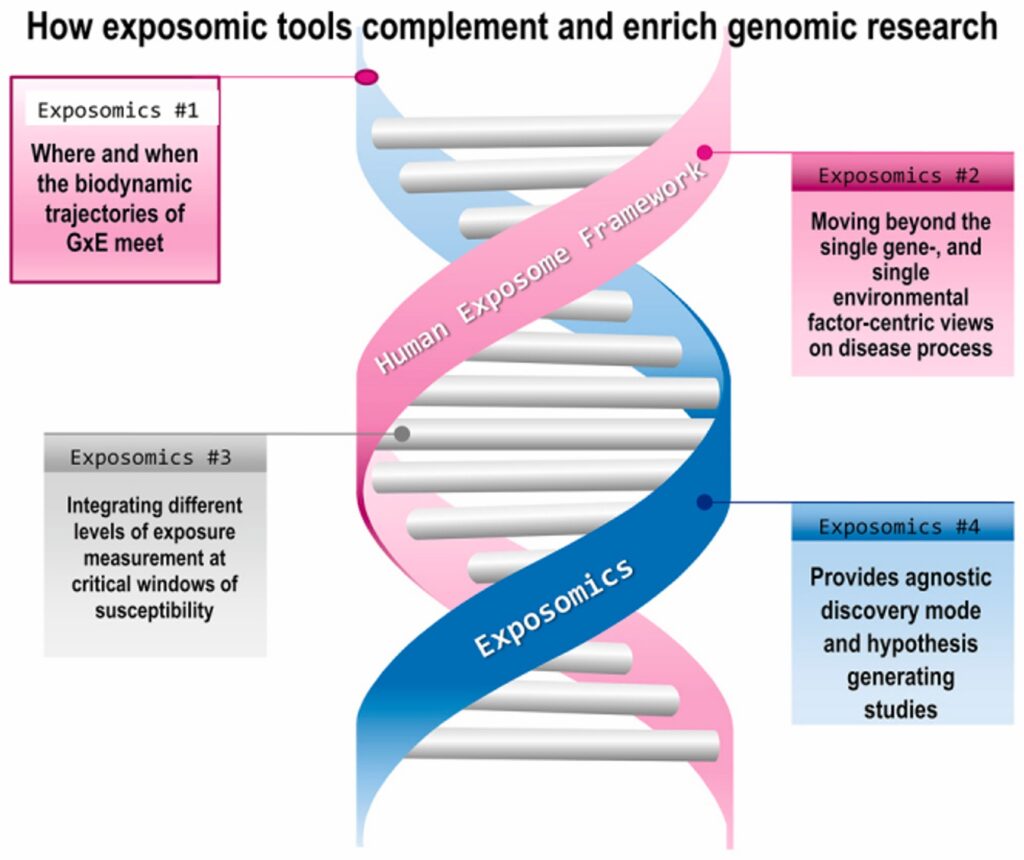
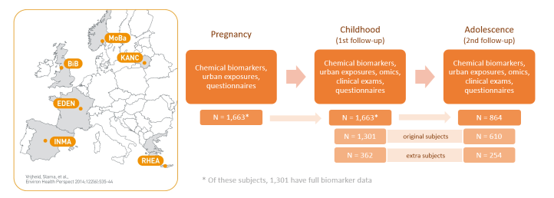
The developmental origins of health and disease (DOHaD) framework, originally proposed by David Barker, provides a strong conceptual basis for the importance of the early-life exposome. Accumulating evidence indicates that exposures during critical windows of fetal and early postnatal development can shape biological systems in ways that influence health across the life course. These exposures included nutrition, infections, socio-economic conditions, environmental chemicals, and metabolic or hormonal perturbations. These early exposomic influences may alter fetal programming through hormonal dysregulation and epigenetic modification, leading to persistent changes in gene expression, endocrine function, and metabolic regulation. As a result, individuals may be predisposed not only to adverse birth outcomes but also to cardiometabolic and other noncommunicable diseases later in life. Moreover, genetic susceptibility can modify the health effects of early-life exposures and interact with cumulative environmental exposures over time, contributing to heterogeneity in disease risk in adulthood. One example is the HELIX project, which represents a collaborative study across longitudinal population-based birth cohort studies in six European countries (France, Greece, Lithuania, Norway, Spain, and the United Kingdom).
Exposomic perspective on environmental health in Asia

Asia faces a growing burden of exposomic health challenges across the life course, driven by the convergence of rapid socioeconomic transition and persistent environmental hazards. The World Health Organization has estimated that a substantial proportion of global disease burden is attributable to modifiable environmental factors, underscoring the importance of comprehensive exposure prevention. Home to nearly half of the world’s population, Asian countries experience marked heterogeneity in genetics, lifestyle, development, and environmental conditions, yet share common pressures including rapid urbanization, industrialization, transboundary pollution, unsustainable consumption patterns, and climate change. These exposures contribute not only to adverse pregnancy and childhood outcomes but also to the rising prevalence of allergic diseases, neurobehavioral disorders, cardiometabolic conditions, and other noncommunicable diseases across adolescence and adulthood. Together, these patterns highlight the need for an exposome-based approach to capture cumulative, correlated exposures over time and to inform context-specific strategies for disease prevention and precision public health in Asia.

Potential Candidates and Platforms for Asian Collaborative Exposomic Studies

Birth cohort studies provide an ideal framework for training the next generation of exposome researchers, as they are uniquely suited to examine how prenatal and early postnatal exposures shape health trajectories from early life into adulthood. In this context, the Birth Cohort Consortium of Asia (BiCCA) represents a mature and sustainable platform from which potential trainees can be drawn.

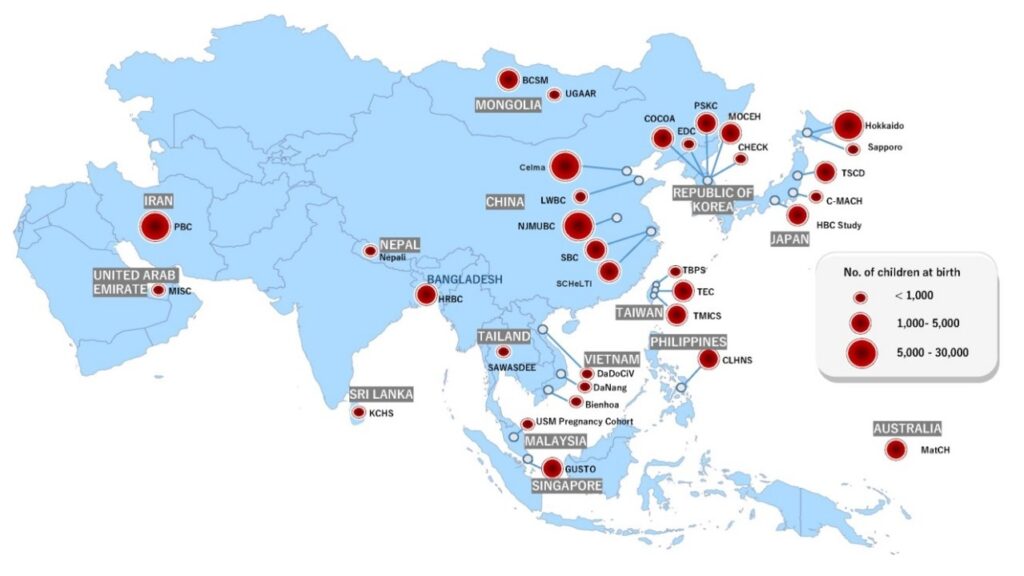
BiCCA was established in 2011 by investigators from Taiwan, Korea, and Japan, and it has expanded into a collaborative network of 34 birth cohorts encompassing approximately 90,000 children across 17 countries in Asia and beyond. Many participating cohorts are led by early- and mid-career investigators managing small- to medium-sized studies with rich exposure and outcome data but limited access to advanced exposomic and statistical training. Therefore, researchers affiliated with BiCCA constitute an ideal target audience for structured, hands-on training in exposome data processing, modeling, and interpretation, enabling more effective use of existing cohort resources and fostering cross-cohort collaboration. The cohort investigators, postdoctoral fellows, junior faculty and students can be a particularly good targets for the potential trainees for Asian Exposome School. Below is the geographic distribution of BiCCA members across 30+ Asia (https://www.bicca.org/)

.
BiCCA PI meeting were held once to twice every year before pandemic of coronavirus disease 2019 (COVID-19). First phase core variable inventory was developed for cohorts to join BiCCA. The infrastructure including scientific committee, bylaws and application process for (internationally cooperative) research proposals was gradually established. With its recent meeting during the International Symposium of Precision Environmental Medicine at Taipei during 2025, BiCCA serves as an international scheme that could be the foundation of Asian Collaborative Exposomic Studies The major events hosted in Taiwan are summarized as follows.

Taiwan as Core Leader of Birth Cohort Consortium of Asia (BiCCA)


Time/Location

Activities

2011

PIs of TBPS (Taiwan), MOCEH (Korea) and Hokkaido Study (Japan) co-established BiCCA

2012 NOV/

Taipei, Taiwan

(1st PI meeting)

The first BiCCA workshop was organized

Three additional cohorts, including the CLHNS (Philippines), GUSTO (Singapore), and the SBC (China) were invited to join the BiCCA

2018 JUN/

Taipei, Taiwan

(10th PI meeting)

Symposium presentation: “Progress of Birth Cohort Consortium of Asia” at the ISEE/ES AC 2018 Conference

Discussion on BiCCA bylaw

2020 AUG/ Online

Symposium presentation: “Recent advance and future collaboration in Birth Cohort Consortium of Asia” at ISEE 2020 Virtual Conference

2022 JUN/ Online

Symposium presentation: “Next steps research of Asian birth cohort” & “Exposure to environmental chemical mixture and maternal and child health in Asia” at ISEE AWPC 2022 Virtual Conference

2023 SEP/ Kaohsiung

“Multi-omics approaches in children environmental health – Birth Cohort Consortium of Asia” at ISEE 2023

2025 NOV/ Taipei

“ENVIRON x HEALTH: Shaping the Future of Precision Medicine”, at ISPEM 2025.

Abbreviation: AWPC, Asia and Western Pacific Chapter; ISEE, International Society for Environmental Epidemiology; ISPEM, International Symposium of Precision Environmental Medicine; PI, principal investigator.

Exposomic Trainings across the Globe

Global exposome research and training efforts are rapidly accelerating in the United States and Europe, underscoring the urgency for comparable capacity building in Asia. Recent initiatives, including the Exposome Moonshot Forum held in Washington, DC, convened hundreds of scientists, policymakers, and stakeholders from across the world to advance exposomics as a core pillar of preventive health and public health policy. In parallel, Europe has invested heavily in structured training programs through international networks such as the International Human Exposome Network, which has implemented train-the-trainer models and intensive exposome schools to disseminate analytical skills globally. These efforts highlight a growing consensus that exposomics must be supported by coordinated education, shared infrastructure, and international collaboration. As exposome science becomes increasingly central to precision prevention and environmental health, it is critical for Taiwan to lead together with our Asian partners and develop comparable, regionally grounded training platforms to ensure that Asia remains an active contributor, rather than a late adopter, in this rapidly evolving field.

Exposome as the pillar of multi-omics approaches

The exposome framework offers a paradigm shift in environmental health research by moving beyond single-exposure assessments toward a comprehensive evaluation of cumulative and interacting exposures across the life course. Traditional exposure science, which typically examines individual chemicals in isolation, cannot adequately capture the complexity of real-world environments where nutrients, environmental toxicants, social factors, and behaviors co-occur and interact with underlying genetic susceptibility. By conceptualizing all external and internal exposures as an integrated system, the exposome provides a unifying framework to study both harmful and protective influences on health. Advances in high-throughput biomonitoring and multi-omics technologies have enhanced the ability to characterize biological responses to complex exposure patterns, helping to link environmental exposures with molecular pathways and disease risk. However, the high dimensionality of exposomic data presents substantial analytical challenges, including correlated exposures, multiple testing, and limited statistical power. Addressing these challenges requires innovative statistical approaches, careful study design, and interdisciplinary collaboration to translate exposome science into actionable evidence for disease prevention and precision public health.

The evolving landscape of environmental exposures and regulatory policies has underscored the limitations of traditional exposure science focused on single chemicals. In real-world settings, individuals experience complex, concurrent exposures to nutrients, environmental toxicants, and social and behavioral factors, often interacting with underlying genetic susceptibility. The exposome framework, which captures the totality of environmental exposures across the life course and their relation to health, provides a unifying structure for studying these cumulative and interacting influences. Within this framework, multi-omics technologies, linking exposomics with genomics, epigenomics, transcriptomics, proteomics, and metabolomics, which can serve as complementary tools to characterize biological responses to complex exposure profiles and to bridge the gap between external exposures and disease phenotypes. However, the high dimensionality of exposomic and multi-omics data presents substantial analytical challenges, including correlated exposures, multiple testing, and data integration. Emerging statistical and machine-learning approaches offer new opportunities to identify nonlinear patterns and interactions within these complex datasets. Together, these advances highlight the need for interdisciplinary collaboration and integrated exposome–multi-omics approaches to identify region-specific environmental threats and inform effective prevention strategies, particularly in rapidly changing environments such as Asia.